SELLING NOTES
SERS vs VERS: What Happens to Your HDB Flat as It Gets Older?
SERS is becoming increasingly rare, while VERS is expected to play a bigger role in the future. Here’s what HDB buyers should understand about the two schemes — and what they mean for an older flat’s value.
Published 10 Sep 2026
SERS vs VERS: What’s the Difference?
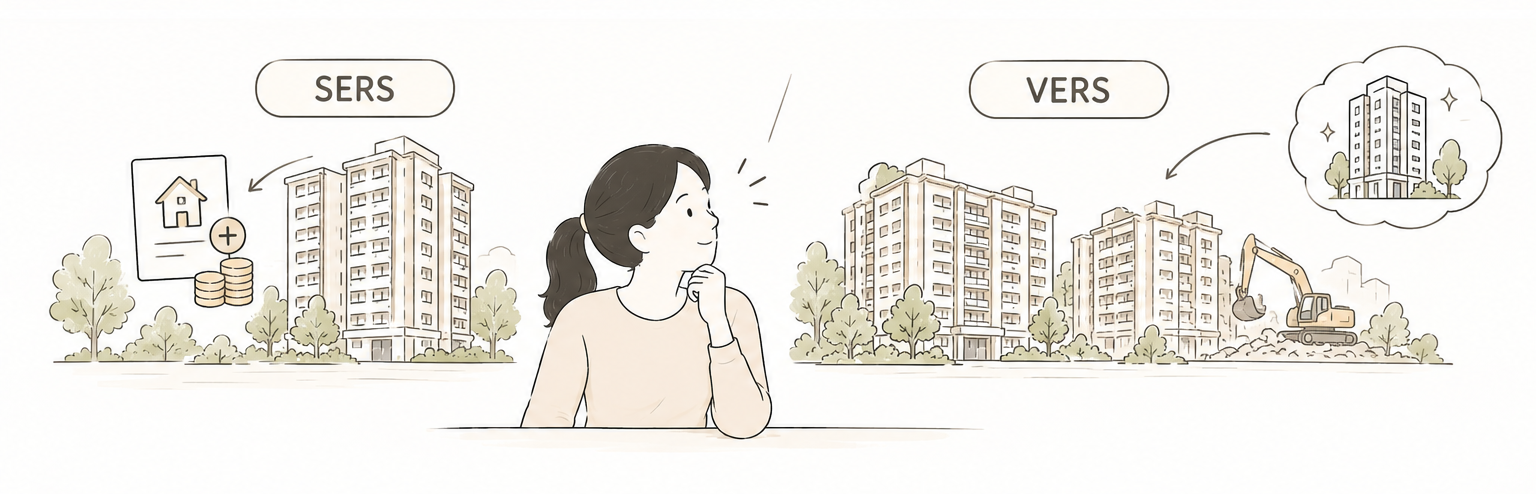
SERS and VERS are often mentioned together, but they work very differently.
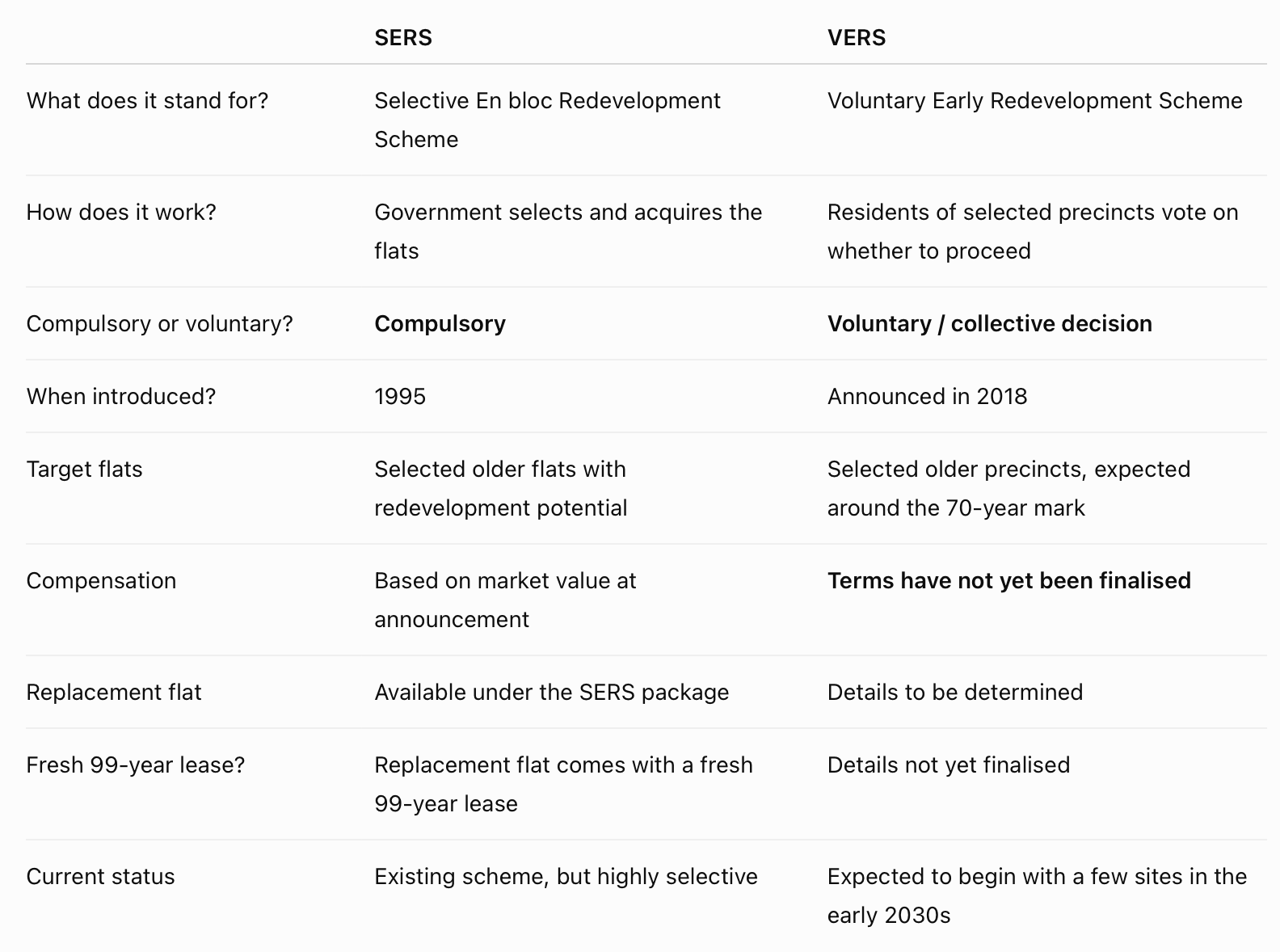
SERS (Selective En bloc Redevelopment Scheme) is a compulsory Government acquisition scheme. HDB selects specific older precincts with redevelopment potential and acquires the flats for redevelopment.
VERS (Voluntary Early Redevelopment Scheme) is intended to give residents of selected older precincts the option to collectively sell their flats back to the Government before the 99-year lease expires.
The important point is that neither should be treated as an automatic outcome for an ageing HDB flat.
SERS has affected only a small proportion of HDB flats since its introduction. The Government has now indicated that it has no plans for further SERS projects, with future estate renewal expected to focus more on VERS and other upgrading programmes.
What Is SERS?
SERS was introduced in 1995 to rejuvenate older HDB estates and make better use of land with strong redevelopment potential.
When a precinct is selected, the Government acquires the affected flats and residents receive compensation based on the market value of their flat at the time of the SERS announcement. Eligible residents are generally offered a replacement flat nearby, with a fresh 99-year lease, or the option of taking compensation and making alternative housing arrangements.
This is very different from a private condominium en bloc sale. There is no vote by residents on whether their block will be selected. The decision sits with HDB and the Government.
SERS is highly selective, and owners should not buy an ageing flat based on the assumption that it will eventually be selected. An old HDB flat does not become a SERS candidate simply because it is old or located in a popular neighbourhood.
So, What Exactly Is VERS?
VERS was first announced in 2018, with the idea of providing another pathway to progressively renew older HDB estates before their leases expire.
Unlike SERS, VERS is intended to involve the residents themselves.
The Government has now said that the first VERS projects will likely begin with a few selected sites in the first half of the 2030s, before being progressively scaled up towards the late 2030s. The exact framework is still being developed, including how sites will be selected, how residents will vote and what compensation package will be offered. That means we should be careful about treating VERS as a confirmed promise of a particular payout or replacement flat.
Why Is the Government Moving Towards VERS?
There is a bigger planning issue behind all of this.
Singapore has entire towns where large numbers of HDB flats were built around the same period in the 1970s and 1980s. If all these flats were simply allowed to reach the end of their 99-year leases at around the same time, the Government could eventually face the challenge of relocating large numbers of residents and rebuilding entire neighbourhoods within a relatively short period.
VERS is intended to allow this renewal to happen gradually rather than all at once. Instead of waiting until the 2070s or 2080s for large numbers of ageing estates to reach lease expiry, redevelopment can potentially be spread across several decades. This is why towns such as Marine Parade, Ang Mo Kio and Bedok are particularly relevant to the longer-term conversation around ageing HDB estates.
Does VERS Mean Your 70-Year-Old Flat Will Be Bought Back?
Not necessarily. The Government has said VERS will be offered to selected precincts when flats reach around 70 years old. It does not mean every HDB flat automatically gets a VERS opportunity once it reaches that age. The final criteria and compensation framework are still being worked out.
So if you're buying a 60-year-old flat today, I would not treat “VERS at 70” as a guaranteed exit strategy.
Will VERS Pay As Much As SERS?
The Government has already indicated that VERS will be less generous than SERS.
SERS typically involves flats being selected because the land has significant redevelopment potential. Owners are compensated based on the market value of their flats at the point of acquisition. VERS, on the other hand, is intended for older estates where the flats are already much further into their 99-year leases.
The Government has specifically said there is less financial upside to VERS, because the flats will be older and therefore the terms are expected to be less generous. But the actual VERS compensation formula has not been finalised, so I wouldn't put a specific dollar value on it at this stage.
What Does This Mean If You're Buying an Older HDB Flat?
Don't buy an old HDB flat because you think it will be the next SERS.
For years, some buyers have been willing to pay a premium for older HDB flats in established neighbourhoods because of the possibility — however remote — that the block might eventually be selected for SERS.
Assess it based on what you know today:
• Remaining lease
• Purchase price
• Location
• Flat size and layout
• MRT and amenities
• School proximity
• Your intended holding period
• Whether the remaining lease works for your future plans
VERS may eventually provide another avenue for selected older estates, but it shouldn't be the main reason you pay a premium for an ageing flat.
Could “70 Years” Become an Important Milestone?
Potentially, yes. Not because every flat will automatically be taken back at 70, but because the introduction of VERS could change how buyers think about the remaining lease.
Today, a buyer may look at a 60-year-old flat and think: “There are still 39 years left.”
In the future, the conversation could become: “What happens when this precinct reaches around 70 years?”
That doesn't mean the flat suddenly becomes worthless at 70. But the possibility of VERS — or the absence of it — could become another factor in how buyers assess older flats. And that makes remaining lease and exit options increasingly important when comparing older HDB flats.
What About HIP II?
HIP II is intended to provide another round of improvements for older HDB flats, around the 60- to 70-year mark.
Interestingly, HIP II and VERS are not mutually exclusive. An older flat could undergo HIP II and later be offered VERS. That makes sense from a planning perspective. VERS will be rolled out gradually over several decades, so some older flats may still need upgrading to remain liveable while waiting for a potential redevelopment opportunity.
For homeowners, this means an ageing flat shouldn't necessarily be viewed as a property that is simply waiting to be demolished. There may be several stages of estate renewal along the way.
The Bigger Picture for HDB Buyers
I think the biggest takeaway from the SERS-to-VERS transition is that Singapore's approach to ageing HDB estates is changing.
SERS was always selective. But because successful SERS cases could result in market-value compensation and a fresh 99-year replacement flat, the scheme created a powerful perception that certain old HDB flats could have significant redevelopment upside. With no further SERS projects currently planned, that “SERS potential” should be treated much more cautiously.
VERS could eventually provide a more structured pathway for selected older estates, but the details are still being developed. For buyers, that means the safest approach is to buy the flat for what it offers today, rather than for a future policy outcome that isn't guaranteed.
Final Thoughts
If you're buying an older HDB flat, I wouldn't ask only: “Could this get SERS or VERS?”
I'd ask: “If neither happens, am I still comfortable owning this flat?”
If the answer is yes, then you are looking at the property based on fundamentals rather than speculation. A good location, practical layout, remaining lease and price that makes sense for your intended holding period will matter regardless of what happens with future redevelopment policies.
SERS may be ending as the main conversation, and VERS is coming, but many of its details are still being worked out. For buyers today, the more important decision is understanding the lease you're actually buying — and whether it works for your plans.
Let's Talk About Your Situation
If this article helped answer some of your questions but raised a few new ones, you're not alone. Every property journey is different. If you'd like to discuss your own situation or have a question after reading this article, feel free to leave me a message below.