BUYING NOTES
HDB vs Condo: What Really Changes When You Buy Private?
Published 24 Sep 2026
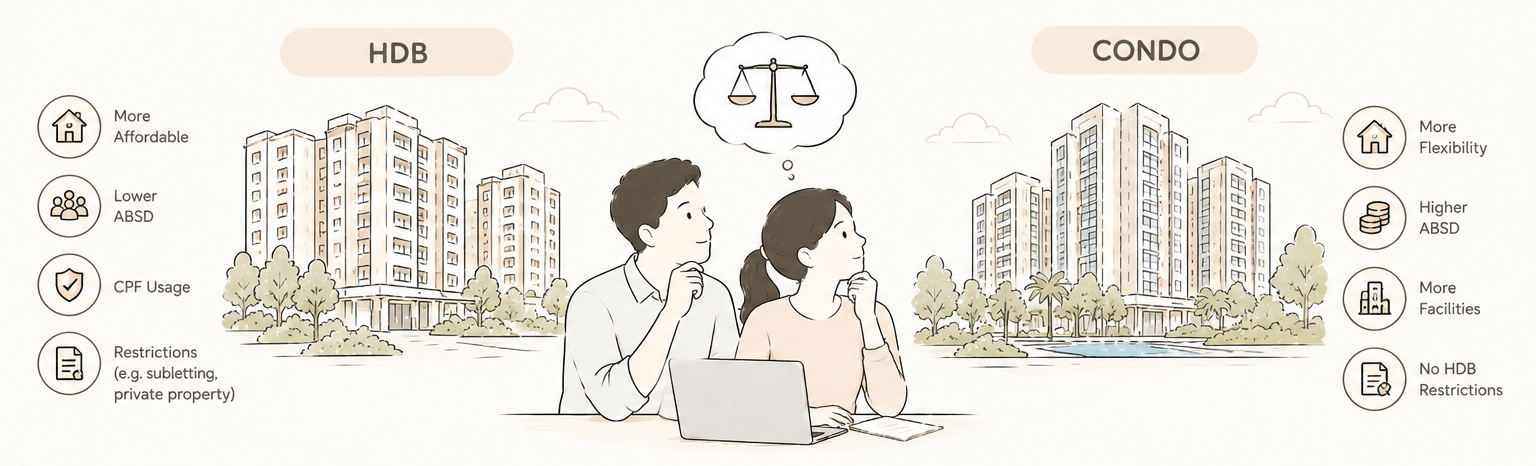
The difference between an HDB and a condo goes beyond price. From space and monthly costs to flexibility and lifestyle, here are the factors worth considering before choosing between the two.
Choosing between an HDB flat and a private condominium is often reduced to one question:
Which one is the better investment?
But property ownership isn't only about potential returns. The choice affects how much you spend, how much space you get, where you can live, how you structure your ownership and even how much financial freedom you have later on.
Instead of looking at HDB and condos through a simple "better or worse" lens, it may be more useful to look at what each property type offers — and what you are giving up in return.
1. Purchase Price and Affordability
HDB flats generally have a lower entry price than private condominiums, particularly when comparing properties of similar size or in similar locations.
This means buying an HDB can leave you with more room in your finances for:
• Savings
• Investments
• Children's expenses
• Retirement planning
• Other financial commitments
A condo, on the other hand, requires a larger financial commitment from the outset.
2. Space vs Facilities
One of the most noticeable differences is the way you use your space.
HDB flats, particularly larger resale units, can offer generous internal space. This can be important for families who prioritise larger bedrooms, living areas, storage and work-from-home space. Condos tend to offer more shared facilities instead.
3. Location Can Change What Your Budget Buys
Your budget may stretch very differently depending on whether you are buying an HDB or condo.
A particular budget could potentially buy a larger resale HDB in a mature, centrally located estate, while the same budget may require you to consider a smaller condo or a different part of Singapore.
This makes location an important part of the comparison.
Think about what matters to your daily life:
• MRT access
• Schools
• Parents and family
• Work commute
• Food and amenities
• Parks and recreation
Sometimes, choosing the property type you want also means compromising on location.
4. Monthly Costs Are More Than Just the Mortgage
The purchase price is only one part of the equation.
For a condo, you also need to account for recurring costs such as monthly maintenance charges, property tax, insurance and other household expenses. HDB ownership generally has lower recurring estate charges, although the actual amount depends on the flat and estate.
There are also differences in renovation, repairs and maintenance depending on whether you are buying a new or older property.
5. Financial Flexibility
A lower-cost property can provide something that is difficult to put a price on: financial breathing room.
If your housing costs are manageable, you may have greater flexibility to:
• Change jobs
• Take a career break
• Travel
• Invest elsewhere
• Prepare for retirement
• Handle unexpected expenses
A condo may provide greater exposure to the private property market, but it also means taking on more financial responsibility. Neither approach is automatically better. It depends on whether your priority is maximising property exposure or maintaining financial flexibility.
6. Ownership and Future Plans
The way you own your property can affect your future options.
HDB ownership comes with specific rules and eligibility requirements, including Minimum Occupation Period requirements and restrictions around future purchases. Private property generally offers more flexibility in terms of ownership structures and subsequent property decisions, subject to financing, tax and regulatory rules.
This becomes particularly relevant for homeowners who may eventually want to:
• Buy another property
• Upgrade again
• Invest in property
• Change their ownership structure
But these strategies should not be considered in isolation. Stamp duties, financing rules and each owner's circumstances can materially affect the outcome.
7. Holding Period and Timing
Property decisions are also affected by time.
An HDB owner may have to meet applicable occupancy requirements before certain future moves can be made.
For private residential property, the Seller's Stamp Duty (SSD) is an important consideration when selling within the applicable holding period.
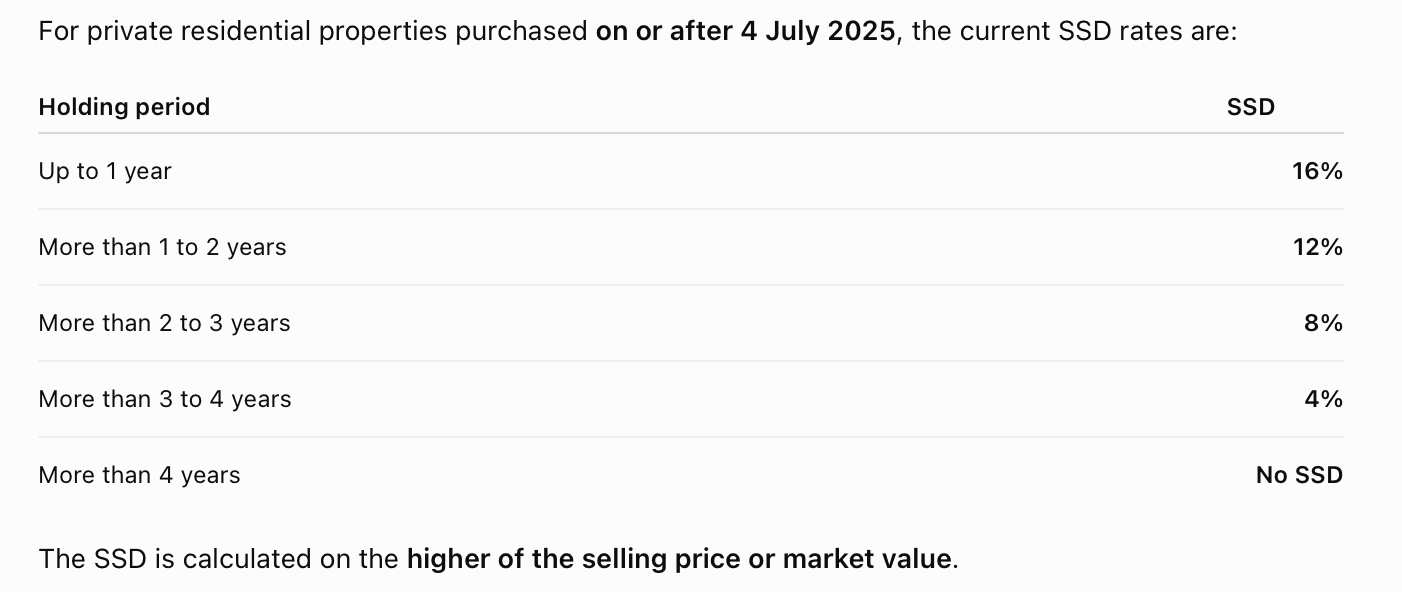
This doesn't mean you should buy or sell according to a fixed timeline. Rather, it highlights why your intended holding period matters before you purchase.
8. Lease Age Matters
This applies to both HDB and private property, particularly when looking at older resale properties.
As a property gets older, buyers may have to consider factors such as:
• Remaining lease
• Financing
• CPF usage
• Future buyer demand
• Potential resaleability
An older property isn't necessarily a bad purchase. But the price should make sense relative to how much usable lease and future flexibility you are receiving.
9. Rental Potential Is Not the Same as Investment Return
Rental income is another area where HDB and condos can differ. Because HDB flats generally have a lower purchase price, the rental yield can sometimes be attractive relative to the purchase quantum.
But rental yield alone does not tell you whether a property is a good investment.
10. Your Living Environment Is Different
There is also a lifestyle difference that cannot be captured in a spreadsheet. A condo may offer a more private, controlled environment with shared recreational facilities within the development. An HDB estate may offer a more open and established neighbourhood environment, with hawker centres, shops, schools and community facilities integrated into the surrounding area. Some people value privacy and facilities. Others value convenience, space and the familiar community environment.
Neither is inherently better.
What Are You Actually Optimising For?
If your priority is:
Keeping housing costs manageable
→ An HDB may fit better.
Having more private recreational facilities
→ A condo may fit better.
Maximising living space
→ A larger HDB may make more sense.
Living in a particular private estate
→ A condo may provide more options in some locations.
Keeping more money available for other goals
→ A lower housing commitment may be preferable.
Building a larger property portfolio in the future
→ Private property may provide different ownership and financing possibilities, but the numbers and applicable rules need to be assessed carefully.
There isn't a universal winner between HDB and condo.
An HDB can offer affordability, space and financial flexibility, while a condo can provide a different ownership structure, private facilities and exposure to the private property market. The important part is understanding what you are paying for and what you are giving up.
Before choosing a property type, look beyond the purchase price and ask: How much will I spend, how will I live, and what options will I have after I buy?
Because the right property isn't necessarily the one with the highest price or the most facilities. It is the one that fits the life and financial position you are trying to build.
Let's Talk About Your Situation
If this article helped answer some of your questions but raised a few new ones, you're not alone. Every property journey is different. If you'd like to discuss your own situation or have a question after reading this article, feel free to leave me a message below.
Disclaimer: This article is for general information and educational purposes only and should not be taken as financial, legal, tax or investment advice. Information may change over time; please verify the latest requirements and seek professional advice where appropriate.