
BUYING NOTES
How to Pick the Right BTO Flat: A Practical Unit-Selection Guide
Published 25 Sep 2026
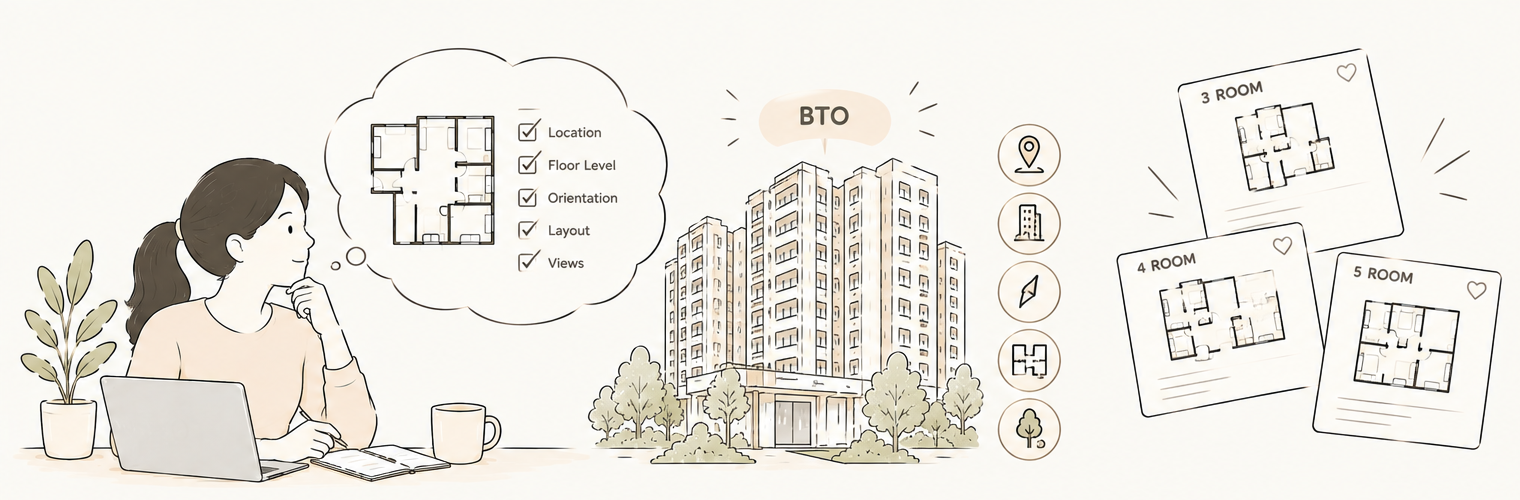
Your queue number may determine what is left, but a little preparation can help you choose the unit that works best for your lifestyle, comfort and future plans.
Getting a BTO flat is only the first part of the process. Once your flat selection appointment arrives, the next question is:
Which unit should you actually choose?
There is no single "best" BTO unit. A high-floor corner unit may be perfect for one household but unnecessary for another. Some buyers prioritise privacy, while others care more about proximity to the MRT, schools or amenities. The goal is not to find a perfect unit. It is to understand the trade-offs before you make your selection.
Here are some things worth checking before your appointment.
1. Start With the Surrounding Area
Before looking at individual units, understand the bigger picture. A BTO site plan shows you the development itself, but it doesn't always tell you what the neighbourhood could look like several years later.
Resources such as the URA Master Plan can help you understand the intended use of surrounding land parcels.
Look out for:
• Future residential developments
• Transport infrastructure
• Commercial sites
• Schools
• Parks and recreational spaces
• Reserved sites
• Changes to surrounding land use
An empty plot next to your block may look attractive today, but it is worth finding out what it is intended for. Don't choose a unit based entirely on today's view.
2. Look at the Actual Location of Your Block
Within a large BTO development, two blocks can have surprisingly different surroundings. One may be close to the MRT or neighbourhood centre, while another could be several minutes further away. That difference may not matter much when you're looking at the site plan, but it can matter in everyday life.
Think about:
• Walking distance to the MRT
• Distance to the bus stop
• Schools and childcare
• Supermarkets
• Food options
• Parks
• Clinics
• Community facilities
If you have elderly parents or young children, even an additional few minutes of walking can make a meaningful difference.
3. Don't Automatically Choose the Block Closest to Everything
Being close to amenities sounds ideal. But convenience can come with a trade-off.
A block beside a playground, coffeeshop, community space or major walkway may experience more:
• Foot traffic
• Noise
• Activity
• Evening movement
• Delivery traffic
Likewise, a block beside an MRT station or main road may offer excellent connectivity but potentially more traffic noise.
When comparing blocks, think about what happens around them, not just how close they are to something.
4. Check What Is Coming Up Around You
The surrounding neighbourhood can change after you move in. Look beyond the current buildings and check planned developments in the area.
A future development could bring:
Potential positives
• New amenities
• Better connectivity
• More shops
• New community facilities
But it could also mean:
Potential trade-offs
• Construction
• New buildings blocking views
• More traffic
• Higher footfall
This is why checking the Master Plan and the project's site plan together can be useful.
5. Consider the Waiting Time
Not every BTO project has the same completion timeline. If you are currently renting, living with parents or facing another time-sensitive situation, the estimated waiting period can become an important consideration.
• A difference of several months may sound insignificant when you first apply, but it can matter if you have:
• A wedding coming up
• A rental agreement ending
• Plans for children
• An existing home that needs to be sold
• Other major life changes
Your preferred unit should fit not only your budget, but also your timeline.
6. Study the Block Orientation
This affects several aspects of your future home.
Views
An unblocked view can be attractive, but don't assume that today's open space will remain open permanently. Check the surrounding land use and proposed developments before treating a view as a permanent feature.
Roads and expressways
Units facing major roads may experience more traffic noise and dust.
Multi-storey car parks
Depending on the unit's floor and orientation, an MSCP can affect your view and privacy.
Common areas
Units facing playgrounds, community spaces or heavily used walkways may experience more activity.
A beautiful-looking site plan can therefore tell a very different story once you consider what is happening around each block.
7. Think About Sun Exposure
Singapore is hot enough without accidentally choosing a home that receives strong afternoon sun. The orientation of your unit can affect how much direct sunlight enters the home, which in turn can influence indoor temperature and cooling needs.
West-facing units are often less popular because of afternoon sun exposure. But don't treat orientation as an automatic deal-breaker.
The actual experience depends on factors such as:
• Unit orientation
• Window placement
• Surrounding blocks
• Shading
• Floor level
• Trees and landscaping
If this matters to you, compare the unit orientation carefully rather than relying only on the compass direction.
8. Floor Level: Higher Isn't Always Better
High-floor units are often popular, but there are trade-offs at every level.
Lower floors
• Potential considerations include:
• More activity and noise
• Greater visibility from common areas
• More exposure to certain pests
• Views that may be blocked by nearby structures
Higher floors
• Potential advantages include:
• More privacy
• Better views
• Less direct exposure to some ground-level activity
But higher floors can also experience greater exposure to wind, sun, heat and longer lift waiting time.
The most important thing is to decide what floor range you are comfortable with before your selection appointment.
9. Look at the Distance Between Blocks
Two blocks may be positioned close enough that units can directly face one another.
That could affect:
• Privacy
• Natural light
• Views
• Visibility into your home
If privacy matters to you, check the distance and orientation between neighbouring blocks. And don't assume that a high floor automatically solves the problem.
10. Corner or Corridor Unit?
If you have several units to choose from, the position of the unit along the corridor is worth considering. A corner unit may offer greater privacy because fewer people walk directly past the entrance.
For other units, check the location of:
• Lift lobby
• Staircase
• Rubbish chute
• Common corridor
• Shared facilities
Being directly beside a lift lobby may be convenient, but it could also mean more movement outside your door. Similarly, being very close to the rubbish chute may be convenient but could bring more activity.
11. Think About the Everyday Details
Some features may seem minor when choosing a flat but become very noticeable after moving in.
For example:
• Where is the rubbish chute?
• How far is the lift?
• Where does the service yard face?
• Is the kitchen ventilated?
• Does the bedroom receive afternoon sun?
• Can you comfortably fit a washer and dryer?
• Is the main bedroom directly beside the living area?
• Is there enough wall space for furniture?
These are the details that you will experience every day for years.
Prepare a Shortlist Before Your Appointment
Your queue number determines which units are still available when your turn arrives. So don't go into the selection appointment with only one "dream unit" in mind. Instead, prepare a shortlist.
For example:
Tier 1 — Preferred
• Best orientation
• Preferred floor
• Good privacy
• Convenient location
Tier 2 — Acceptable
• One or two compromises
• Still works for your lifestyle
Tier 3 — Backup
• More compromises
• But still a unit you would be comfortable living in
This makes the actual selection process much less stressful.
Final Thoughts
There is no perfect BTO unit. A unit with the best view may not have the best orientation.
A high-floor unit may have better privacy but cost more. A block near the MRT may be convenient but busier.
That's why choosing a BTO unit isn't about finding the unit that looks best on paper. It's about knowing which compromises you are comfortable making.
Before your selection appointment, study the site plan, understand the surrounding area, shortlist your preferred units and decide your non-negotiables. And if possible, visit the neighbourhood at different times of the day.
A map can tell you where everything is. But only being there can tell you what it actually feels like to live there.
Let's Talk About Your Situation
If this article helped answer some of your questions but raised a few new ones, you're not alone. Every property journey is different. If you'd like to discuss your own situation or have a question after reading this article, feel free to leave me a message below.
Disclaimer: This article is for general information and educational purposes only and should not be taken as financial, legal, tax or investment advice. Information may change over time; please verify the latest requirements and seek professional advice where appropriate.