BUYING NOTES
Buying a Home Near a Popular Primary School: Is the 1km Advantage Changing?
The latest Primary 1 registration changes could reshape how parents think about school proximity — and the properties they are willing to pay a premium for.
Published 12 Sep 2026
If you’ve only got a minute:
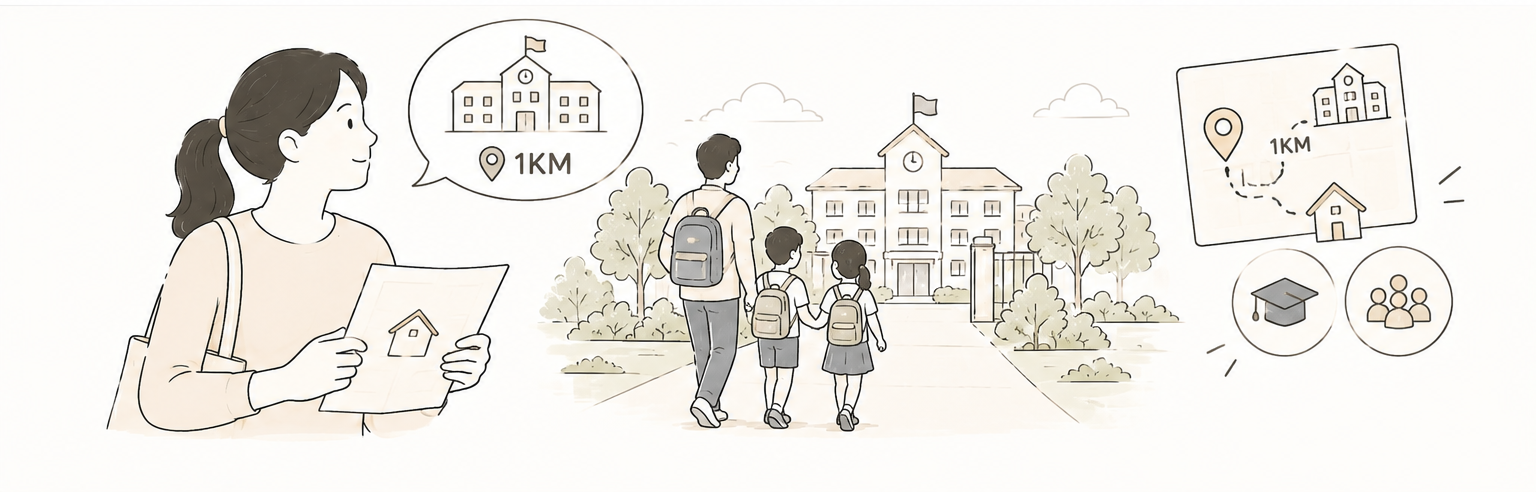
• From the 2027 P1 Registration Exercise, 12 popular primary schools will introduce a new two-track system for Phase 2C, with places split between children living within 2km and beyond 2km. For these schools, living within 1km will no longer give an additional distance advantage within Phase 2C.
• This could open up more housing options for parents who previously felt they had to live very close to a particular school. It does not mean school proximity will stop mattering. Location, convenience and the ability to walk to school still have real value to families.
• If you are buying mainly because of a school, consider the actual lifestyle benefit, your financial commitment and how long you intend to stay, rather than assuming the property will command a premium forever.
For years, school location has been part of the property search
In Singapore, buying a home is sometimes about more than the home itself. For families with young children, the location of a primary school can become one of the biggest considerations when deciding where to live.
A home within 1km of a popular primary school could previously feel particularly attractive. For some parents, the calculation was simple: pay more for the right location today in exchange for a better chance of securing the school they wanted tomorrow. This has contributed to strong demand for certain homes in popular school neighbourhoods.
But the rules are changing.
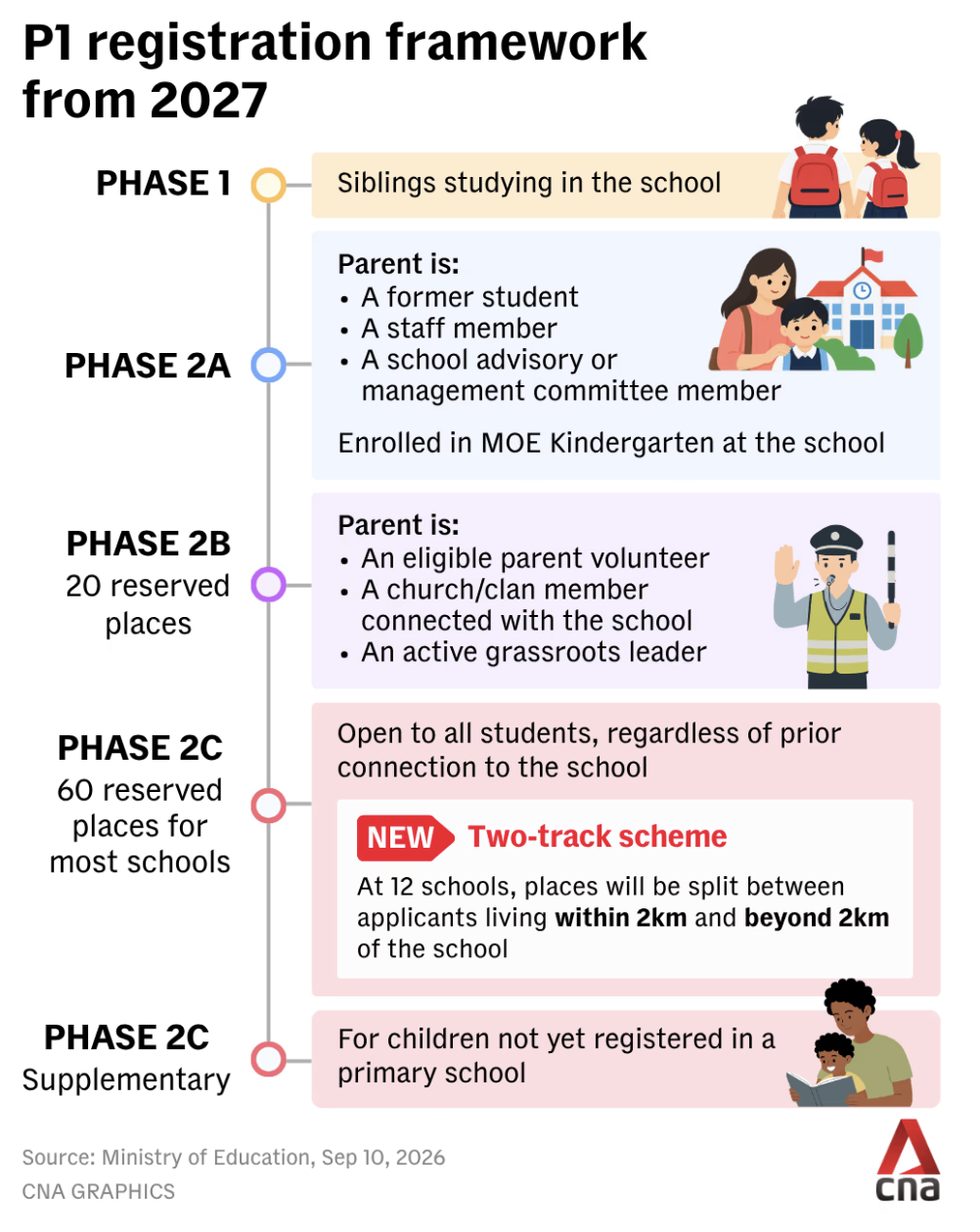
From the 2027 Primary 1 Registration Exercise, MOE will introduce a new two-track system for Phase 2C at 12 primary schools. The 60 reserved Phase 2C places will be split equally between:
1. children living within 2km of the school; and
2. children living more than 2km from the school.There will be no further home-school distance priority within either track.
In other words, for these 12 schools, being 500m away will not give you an additional Phase 2C advantage over another Singapore Citizen family living 1.5km away.
That is quite a meaningful change in the way parents may approach their property search.
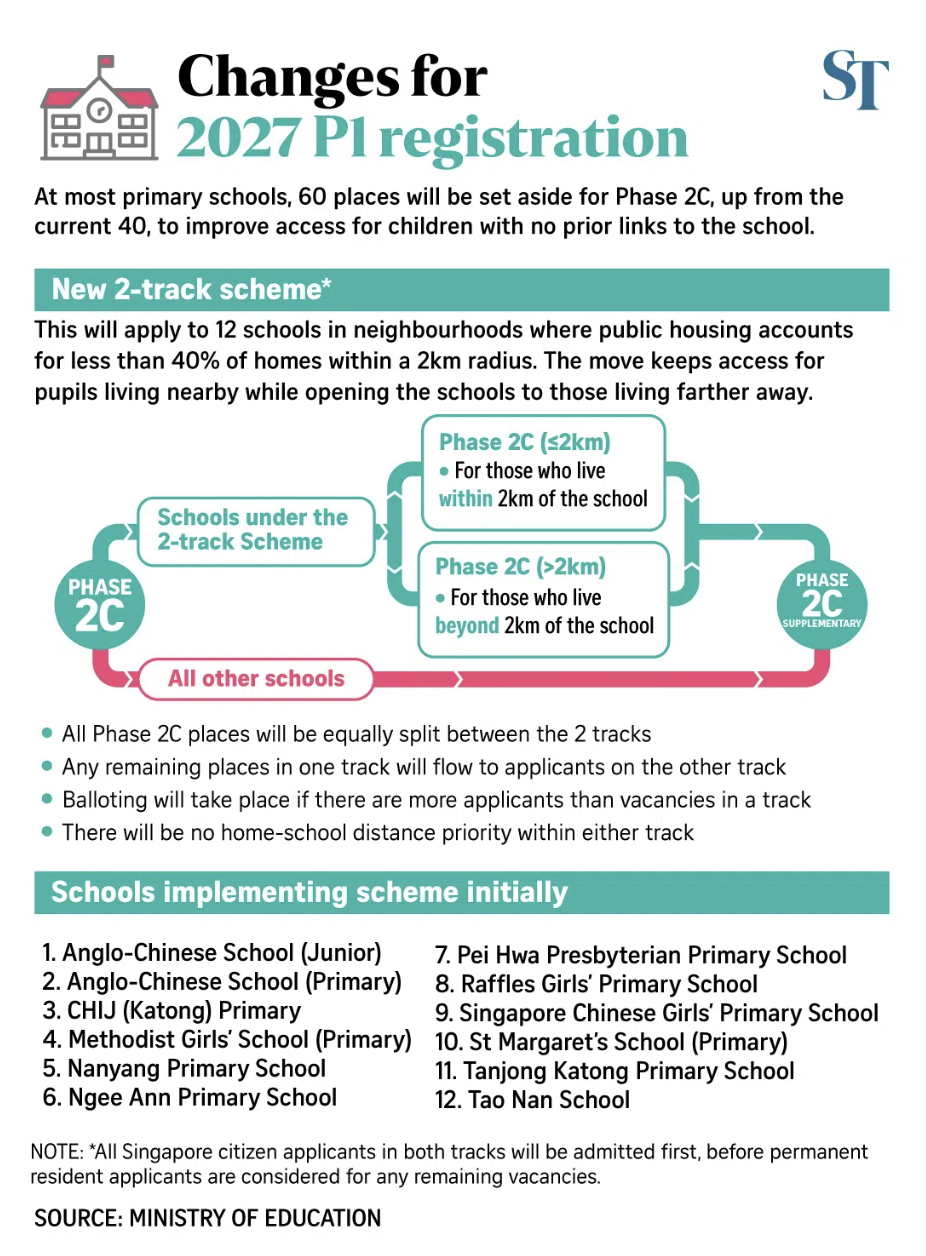
What exactly is changing?
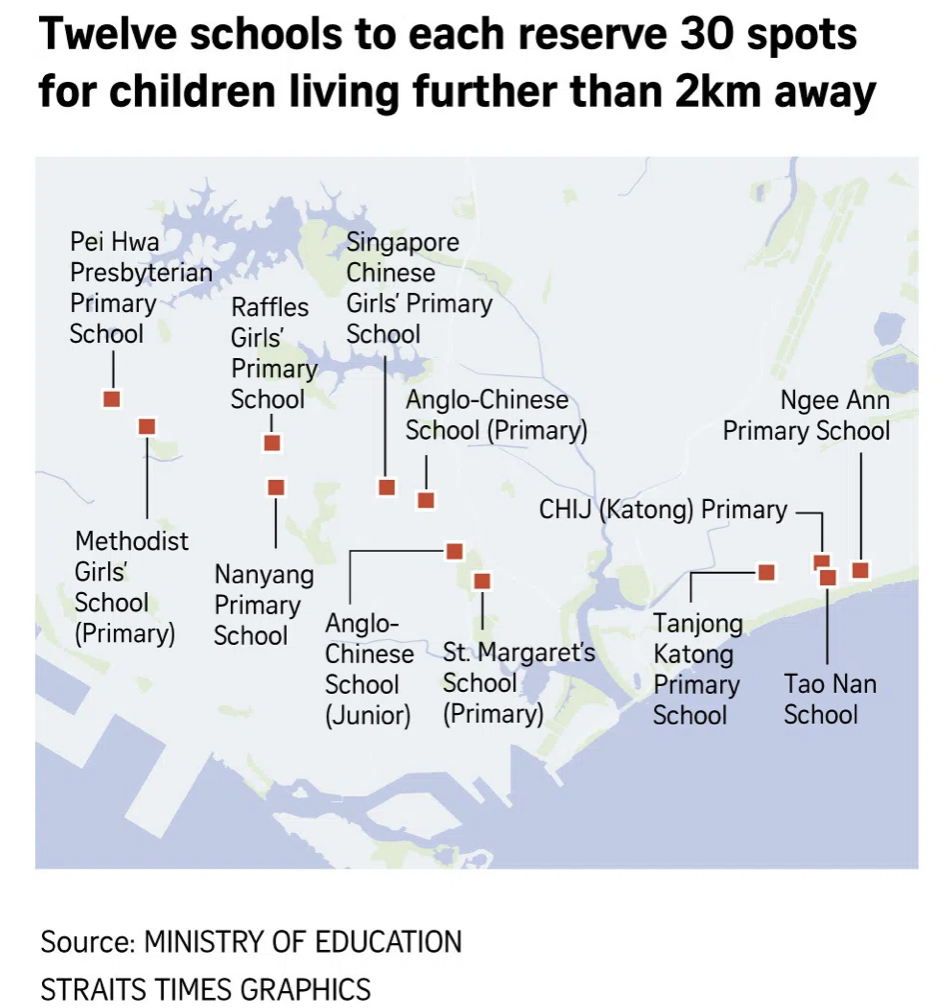
These schools were selected because public housing accounts for less than 40% of dwelling units within 2km. Under the new arrangement, Phase 2C will still have 60 reserved places, but the places will be divided equally between the two distance groups. If there are more Singapore Citizen applicants than available places within either track, balloting will still take place.
Example: A family living 800m away and another living 1.8km away will now be competing within the same "within 2km" track, rather than the closer home receiving an additional distance advantage.
Does this mean living near a popular school matters less?
Potentially — but I wouldn't go as far as saying that proximity no longer matters.
While the admission advantage of being extremely close may narrow, the lifestyle value of a good location remains.
Could this change property demand around these schools?
For years, some parents have been willing to pay a premium for homes that fall within a particularly desirable school radius. If the admission advantage between 1km and 2km becomes less significant for the 12 affected schools, some families may no longer feel that they need to compete for the most expensive homes immediately surrounding the school.
Instead, they may have a wider search area. A property that is 1.5km away might suddenly become more relevant to a family that previously focused almost exclusively on properties within 1km. And a property just outside the 2km boundary — which may previously have been dismissed altogether — could also become worth considering for families willing to participate in the new beyond-2km track. This potentially broadens the pool of homes that parents consider. It doesn't necessarily mean that properties within 1km will suddenly become cheaper.
There are too many other factors affecting property prices — including MRT access, amenities, development quality, tenure, project age, unit attributes and overall demand. But it could mean that the school-related premium becomes less concentrated around the immediate surroundings of certain schools.
Could other schools be affected in future?
This is probably one of the more important things for property buyers to watch. MOE has said that it will periodically review the list of schools under the two-track scheme, taking into account changes in the surrounding housing profiles and the experience of implementing the new arrangement.
So the current list should not necessarily be treated as permanent. At the same time, MOE said it does not expect frequent changes because housing profiles generally do not change drastically over a short period. This means parents buying property today should be careful about assuming that a particular school will always operate under the same admission framework.
The broader takeaway is: School policies can change. Property is a much longer-term commitment. A home purchased when a particular admission rule is in place could still be your home many years after the rules have changed.
Does this mean parents should stop paying for homes near popular schools?
If living close to a school genuinely improves your family's daily life, there is still a reason to pay for that convenience. But I would be more cautious about paying a very large premium purely for admission probability.
For example, imagine two otherwise comparable properties. One is significantly more expensive because it is within a particularly sought-after school radius. The other is slightly further away, but still within 2km, and offers a much more comfortable price point. Under the new framework, the second property may deserve a closer look.
What should parents do now?
1. Don't start with the school. Start with the family.
Consider your commute, grandparents, childcare arrangements, MRT access, amenities and the amount of time your child will spend travelling every day. A school that looks ideal on paper may not make sense if the rest of your family's routine becomes unnecessarily difficult.
2. Expand your search radius
For families targeting one of the 12 schools, the new rules could create an opportunity to look beyond the most tightly contested areas. Don't automatically dismiss a property because it is 1.5km away when you previously wanted to be within 1km. Likewise, if the property is beyond 2km, understand that the new Phase 2C track may give you a route that did not exist under the previous distance structure. But remember: balloting still applies. There is no guarantee of admission simply because you live within 2km — or even because you live very close to the school.
3. Don't forget the 30-month rule
If you're buying a property specifically to rely on your residential address for P1 registration, the stay requirement remains an important consideration. For a resale property, the family must generally have stayed at the address for at least 30 months from the start of the child's P1 school term to qualify for the relevant home-school distance priority. For a new property, MOE uses the Vacant Possession Date (VPD) rather than the developer's estimated TOP date when determining the relevant timeline. This is one reason why parents should not leave the property decision until the year immediately before P1 registration.
4. Look beyond the admission year
Your child may only spend six years in primary school. Your property could be a 10, 15 or even 20-year commitment. So ask yourself: Would I still want to own this property if my child attended a different school?
What about property prices?
Property prices rarely move because of one factor alone, and school proximity is only one part of the equation.
Some properties may continue to command strong prices because they offer a combination of:
• proximity to schools
• MRT access
• established amenities
• good connectivity
• limited housing supply
• desirable development characteristics
• strong owner-occupier demand
What could change is the behaviour of the marginal buyer. If fewer parents feel they absolutely need to buy within the closest possible radius, they may become more price-sensitive and consider a wider range of properties. Over time, that could moderate some of the urgency — and potentially some of the premium — associated with being right next to a popular school. But that is very different from saying that school-area properties will suddenly lose their value.
Perhaps the bigger opportunity is for homes just outside the traditional "school zone"
Previously, a parent might look at a map and mentally draw a hard line around the school.
Within 1km: consider.
1–2km: maybe.
Beyond 2km: probably not.
The new framework potentially makes that line less rigid. For the 12 affected schools, a property at 1.8km could become more attractive relative to one at 800m if the price difference is substantial. And properties beyond 2km now have a separate opportunity to compete for reserved Phase 2C places.
This doesn't eliminate the value of location. It simply gives parents more locations to choose from. And more choice can be a good thing for buyers.
So, should parents change their property plans?
I wouldn't rush to buy — or sell — because of this announcement.
1. Don't forget why the rules are changing
It is easy to view this purely through the lens of property. But the policy objective is broader. MOE wants to improve access to popular schools and encourage a more diverse mix of students. The two-track approach is particularly relevant in neighbourhoods where public housing makes up a relatively small proportion of homes. The changes are therefore not designed to make certain properties less valuable. They are designed to make access to schools less dependent on living as close as possible to the school.
2. Ultimately, your child's health matters more than the school name
We talk about schools in terms of rankings, balloting, affiliations and resale values. But at the end of the day, your child is going to live the daily reality of that decision. A slightly less "branded" school that is a short walk from home may mean more sleep, less commuting and more time for rest, play and family. A home that requires stretching your finances significantly just to get closer to a particular school may create stress elsewhere. And a child spending an hour commuting each way simply because the school has a certain reputation may not necessarily benefit from that trade-off.
There is no single "best" school or "best" property. There is only the combination that makes sense for your child and your family.
Final Thoughts
Primary school proximity has always been an important consideration for many Singaporean families — and it will probably remain one. But the latest changes may give parents more flexibility in how they approach the property search.
Instead of asking only "How close can I get to the school?", it may be worth asking: "What home gives my family the best overall balance of school access, lifestyle and finances?" Because property decisions last much longer than any single P1 registration exercise.
If you're comparing properties based on school proximity, price, commute and your family's longer-term plans, I can help you look at the numbers beyond just the 1km or 2km radius. Let's have a conversation about what actually makes sense for your family.
Let's Talk About Your Situation
If this article helped answer some of your questions but raised a few new ones, you're not alone. Every property journey is different. If you'd like to discuss your own situation or have a question after reading this article, feel free to leave me a message below.