INVESTING NOTES
Buying Property in Malaysia as a Singaporean: What You Need to Know Before You Invest
Malaysia may offer Singaporeans more space, lower entry prices and proximity to Singapore — but buying across the Causeway is not simply a cheaper version of investing in Singapore. Here are the key rules, costs and considerations to understand before you commit.
Published 14 Sep 2026

Buying Property in Malaysia as a Singaporean: What You Need to Know Before You Invest
For Singaporeans, Malaysia has always been a relatively familiar overseas property market. Johor Bahru is just across the Causeway, Kuala Lumpur is a short flight away, and property prices can look considerably lower than what we are used to seeing in Singapore.
With the RTS Link, the Johor-Singapore Special Economic Zone and growing interest in cross-border living, it is understandable why Malaysian property has started appearing on more investors' radar again.
But a lower price tag does not automatically mean a better investment. Malaysia is a different property market, with different rules for foreign buyers, state-level restrictions, taxes and exit considerations. Before looking at the size of the condo or the price per square foot, there are a few things worth understanding first.
1. Yes, Singaporeans can buy property in Malaysia
Singaporeans are generally allowed to purchase property in Malaysia as foreign buyers. However, foreign ownership rules are not exactly the same across the country.
Malaysia's property regulations are administered at the state level, so the minimum purchase price and types of property foreigners can buy may differ depending on where you are looking.
This can affect:
• Minimum purchase price
• Types of properties foreigners can buy
• Whether state authority consent is required
• Restrictions on landed property
• Certain reserved or restricted properties
• Fees payable by foreign purchasers
In many popular markets such as Johor and Kuala Lumpur, foreign buyers will commonly encounter a RM1 million minimum purchase threshold, although there are exceptions depending on the state, property type and development.
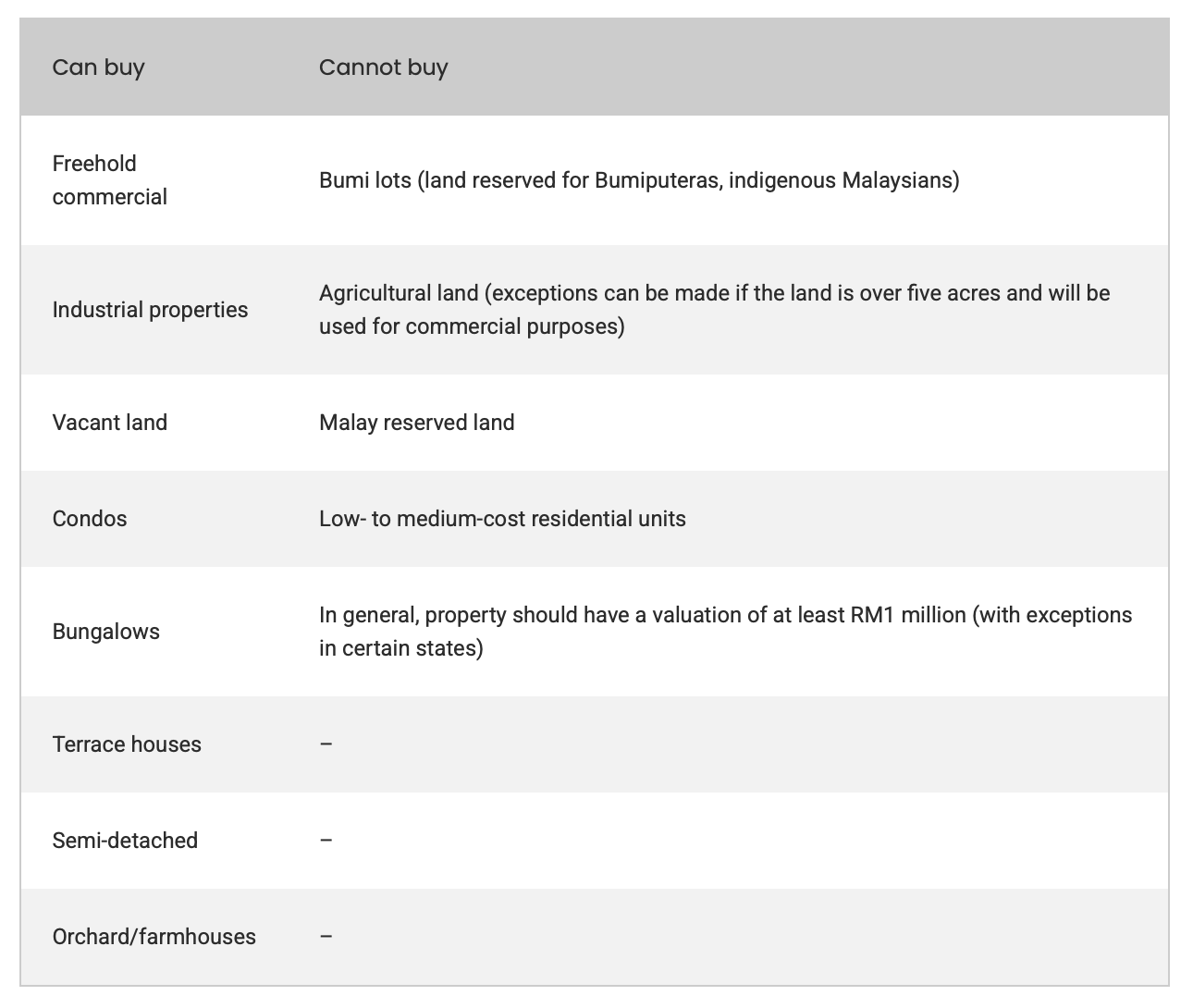
2. Not every Malaysian property is available to foreign buyers
Price isn't the only restriction. There are categories of Malaysian property that foreigners generally cannot purchase, such as:
3. Buying in Johor is not the same as buying in Singapore
Johor naturally attracts a lot of attention from Singaporean investors.
The RTS can improve connectivity. The JS-SEZ can potentially create jobs and economic activity. But that does not mean every condominium in Johor Bahru will automatically appreciate. There can still be differences between projects, locations, tenure, maintenance standards, supply and tenant demand.
4. You can't use your CPF to buy a Malaysian property
CPF savings cannot be used to purchase property outside Singapore. So unlike an eligible Singapore property purchase, you cannot rely on your CPF Ordinary Account to fund the Malaysian property purchase.
So if you're purchasing a Malaysian property, you will need to fund the purchase through cash and/or financing arrangements available to you. If you are considering a Malaysian mortgage, compare the financing terms carefully rather than assuming the interest rate and loan structure will work in the same way as a Singapore property loan.
Your Malaysian property may be cheaper, but that doesn't mean the investment is automatically easier to finance.
5. What if you already own an HDB flat?
This is where Singapore-specific rules come back into the picture.
If you own an HDB flat, you should first check whether you have fulfilled the applicable Minimum Occupation Period (MOP) and whether there are any additional restrictions attached to your flat.
The fact that the Malaysian property is overseas does not mean you should ignore your existing HDB obligations. For example, households with newer housing models such as Prime or Plus flats may have longer MOPs and additional conditions.
6. The price you see isn't necessarily the cost of buying
A RM1 million property does not mean you simply need RM1 million. Foreign buyers need to account for additional transaction costs, which can include:
•Stamp duty
• State consent fees
• Legal fees
• Financing costs
• Maintenance fees and sinking fund
• Assessment tax and quit rent
• Periods where the property is vacant
• Repairs and renovation
I• nsurance
• Agent Fees
and more...
The exact amount depends on the property and state, so it is important to work out the all-in purchase cost before comparing Malaysian property with alternatives in Singapore. A property that looks attractive at RM1 million may look quite different once you add the acquisition costs and financing.
7. Do Singaporeans need MM2H to buy property?
No. You do not need Malaysia My Second Home (MM2H) simply to purchase Malaysian property.
But MM2H is worth understanding if your intention goes beyond investing and you may actually want to spend a significant amount of time living in Malaysia.
What is MM2H?
Malaysia My Second Home (MM2H) is a long-term residency programme for eligible foreigners who want to live in Malaysia.
Buying a Malaysian property does not automatically give you long-term residency rights in Malaysia.
If your plan is simply to own an investment property and visit occasionally, MM2H may not be necessary.
If your plan is to eventually split your time between Singapore and Malaysia, the residency aspect becomes much more relevant.
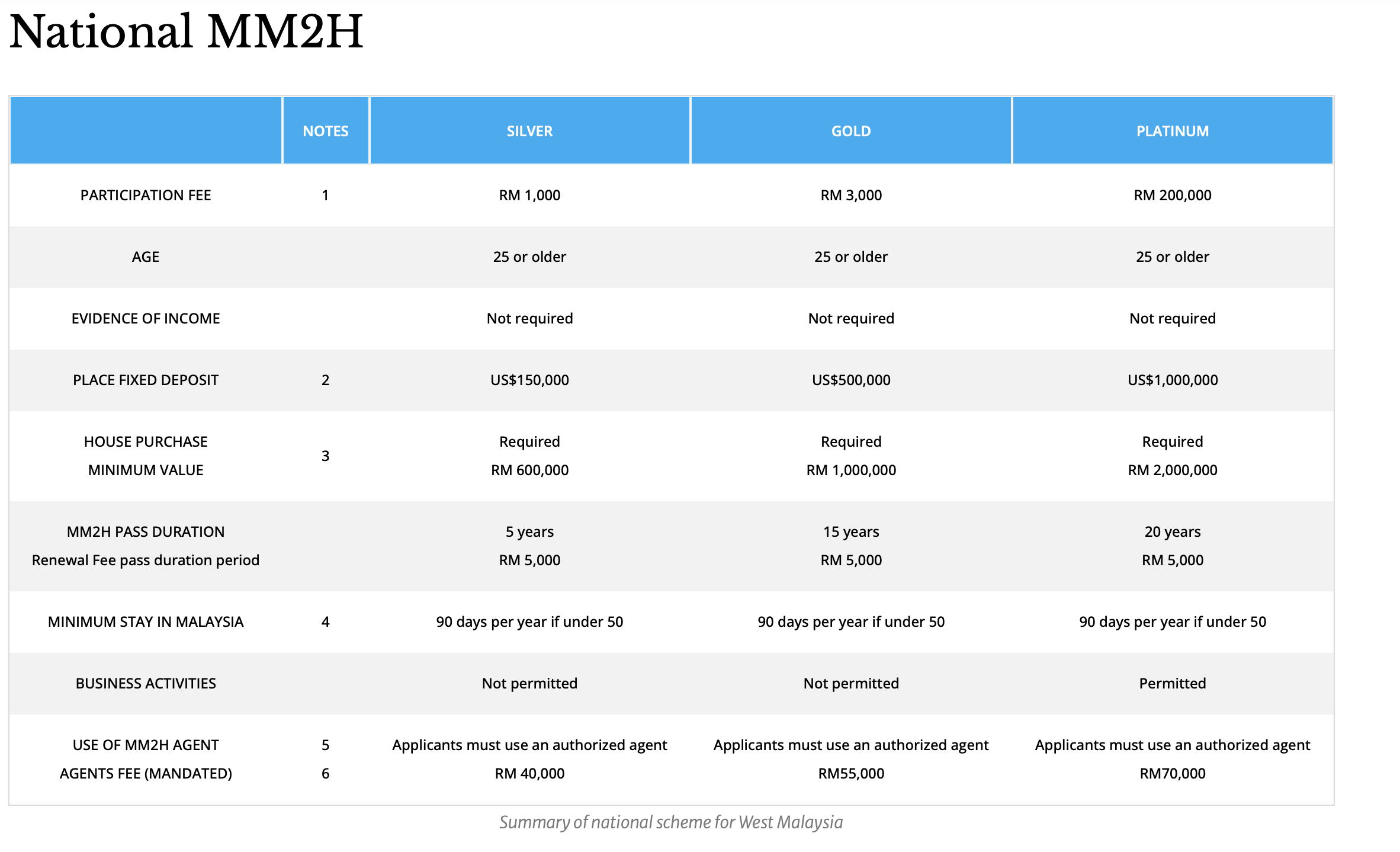
* The 90-day annual stay requirement applies to principals below 50 under the programme information provided.
There is also a Special Economic Zone / Special Financial Zone (SEZ/SFZ) category, which has different requirements and is particularly relevant to parts of Johor.
8. MM2H is not simply a “property visa”
Under the current national MM2H structure, participants are required to purchase a residential property meeting the relevant minimum value within the stipulated period.
The property also comes with restrictions on disposal — including a 10-year holding requirement under the programme, unless specific conditions such as upgrading apply.
There is also a substantial fixed-deposit requirement. Up to 50% of the fixed deposit may be withdrawn after approval for permitted purposes such as property purchase, medical expenses, education or tourism, subject to the programme's conditions.
So MM2H should be viewed as a residency programme with financial and property commitments, rather than simply a way of getting cheaper property.
9. New launch doesn't automatically mean safer
Singaporeans are familiar with buying new launches. Malaysia has its own new-launch market, but there is another layer to consider: whether the development falls under the Housing Development (Control and Licensing) Act (HDA).
For eligible residential developments, HDA provides certain protections around the purchase process, construction and defects. However, not every property marketed as a residential investment necessarily receives the same treatment.
This is particularly relevant when you come across serviced apartments, commercial-titled developments or projects marketed heavily around short-term rental potential.
10. Remember the currency risk
Your property is denominated in ringgit, while your financial life may largely be in Singapore dollars.
Let's say you buy a property for RM1 million.If the property increases to RM1.2 million, that looks like a 20% increase in ringgit terms. But your actual return in Singapore dollars depends on the exchange rate when you sell.
The same applies to rental income. If your tenant pays you RM3,500 a month, that's RM3,500 — not S$3,500. Currency movements can work in your favour, or against you.
This doesn't necessarily make Malaysian property a bad investment. It simply means currency should be part of the calculation, rather than something you only think about when you eventually sell.
11. Malaysia has its own tax system
Rental income generated from Malaysian property can be subject to Malaysian income tax. If you're a Singaporean who is not a Malaysian tax resident, the applicable tax treatment can be different from that of a Malaysian tax resident.
There can also be tax implications when you eventually sell the property, including Real Property Gains Tax (RPGT). The amount payable depends on factors including the seller's status and how long the property has been held.
This is particularly important for investors who are hoping to buy, renovate and flip a property quickly. The transaction may look profitable on paper, but once you factor in: purchase costs + financing + holding costs + selling costs + taxes the actual profit can be considerably smaller.
So, is Malaysian property a good investment for a Singaporean?
There isn't a blanket yes or no.
Malaysia can make sense if you have a long-term view, understand the local market and are comfortable with the currency, regulatory and exit risks. It can also make sense if the property serves more than one purpose — for example, an investment that you could eventually use as a second home.
Do your homework before you buy. Malaysian property can be an interesting addition to a Singaporean investor's portfolio, particularly as Johor becomes increasingly connected to Singapore. However, the rules are different, the taxes are different and the financing is different. And ultimately, you're investing in a different property market.
Study the surrounding neighbourhood, employment nodes, transport connectivity, population growth, tenant profile, competing developments and future supply. And most importantly, calculate your returns after all costs, not just based on the advertised rental yield or potential capital appreciation.
Before you buy, ask yourself:
1. Am I buying for rental income, capital growth, personal use — or all three?
2. What are my total acquisition and holding costs?
3. Who is my likely tenant?
4. Who is my likely buyer when I want to exit?
5. What happens if I cannot sell for the next 5–10 years?
6. Am I comfortable with the currency and regulatory risks?
7. Do I actually need MM2H, or do I simply want to own an investment property?
Sometimes the best overseas property investment isn't the one with the lowest price. It's the one where you understand exactly what you're buying, why you're buying it, and how you plan to get out.
Final Thoughts
Buying property overseas can be a useful way to diversify, but it also means stepping outside the system you're already familiar with. The appeal of Malaysian property is easy to understand. Malaysia may be next door, but next door doesn't mean the rules are the same.
Just don't let the excitement of a lower price make the investment decision for you. The best overseas property isn't necessarily the one that looks cheapest from Singapore. It's the one where the numbers, demand and exit strategy still make sense after you look a little closer.
Let's Talk About Your Situation
If this article helped answer some of your questions but raised a few new ones, you're not alone. Every property journey is different. If you'd like to discuss your own situation or have a question after reading this article, feel free to leave me a message below.