BUYING NOTES
HDB Essential Occupier: What You Should Know Before Buying a Second Property
Published 21 Sep 2026
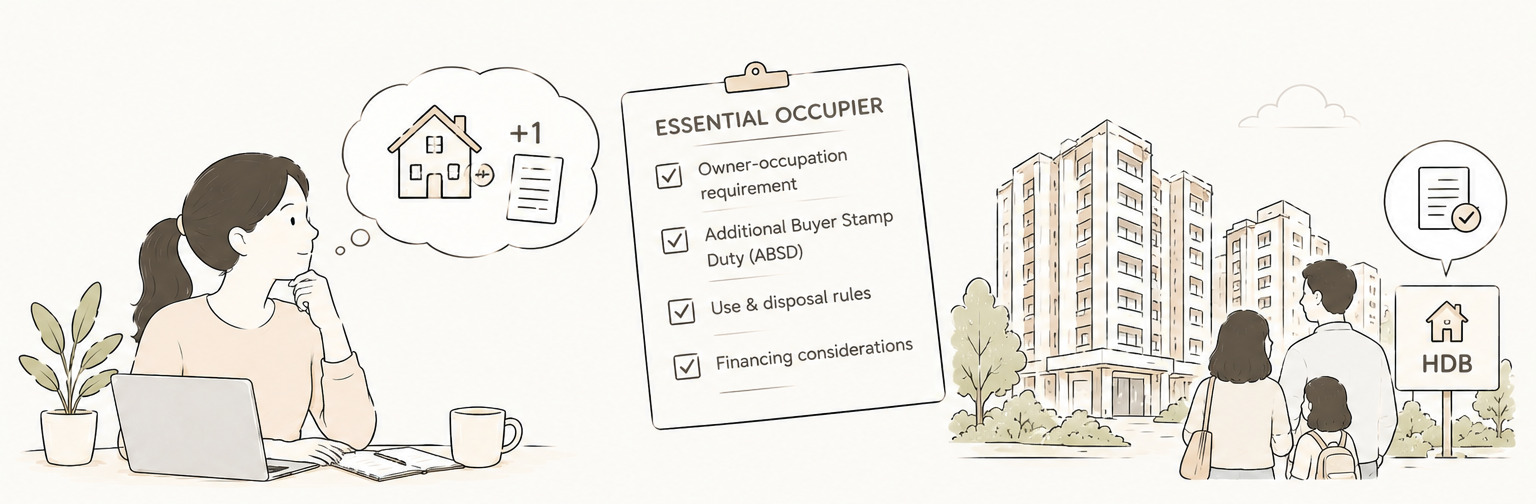
An Essential Occupier arrangement can affect how property ownership is structured between spouses — but there are important trade-offs to understand before considering a future private property purchase.
What Is an HDB Essential Occupier?
When purchasing an HDB flat, the flat can be structured with one person as the owner and another eligible family member as an Essential Occupier. The key difference is that the Essential Occupier lives in the flat but is not a registered owner of the property.
For example, a married couple could have:
Spouse A — HDB owner
Spouse B — Essential Occupier
This is different from a typical joint ownership arrangement where both spouses own the flat. An Essential Occupier arrangement exists primarily to meet HDB's eligibility requirements for certain households and housing schemes. It should not be viewed simply as a mechanism created for purchasing another property.
Why Does the Ownership Structure Matter?
The distinction becomes relevant when the couple later considers purchasing a private property.Because the Essential Occupier is not an owner of the HDB flat, their property ownership position is different from that of the registered HDB owner. After the applicable Minimum Occupation Period (MOP) and other requirements have been fulfilled, the Essential Occupier may potentially purchase a private property in their own name.
However, whether ABSD is payable depends on the individual's circumstances and the applicable stamp-duty rules at the time of purchase.
Who Can Be an Essential Occupier?
An Essential Occupier generally needs to form part of the household that qualifies for the HDB flat.
Depending on the scheme and circumstances, this can include family members such as:
• Spouse
• Parents
• Children
• Siblings
The exact eligibility requirements depend on the HDB flat and household circumstances, so it is important to check the rules that apply to your particular application.
What If You Already Own an HDB Flat Jointly?
If you already own your HDB flat under a joint ownership arrangement, you generally cannot simply change the ownership structure because you have decided that one spouse should become an Essential Occupier.
Changes to the manner of holding an HDB flat are subject to HDB's rules and are not something homeowners can freely restructure whenever they wish. In some circumstances, owners may need to consider selling their existing flat and applying for another flat under an appropriate ownership arrangement instead.
This is why the ownership structure is something worth considering before purchasing the HDB flat, rather than treating it as something that can easily be changed later.
What Are the Potential Advantages?
1. It may preserve a spouse's property ownership position
The Essential Occupier is not a co-owner of the HDB flat. This means the spouse's own property ownership position can remain different from the registered HDB owner. That may become relevant if the household later considers purchasing a private property.
2. It can allow the household to hold an HDB flat and private property
Subject to the prevailing HDB, stamp-duty and property ownership rules, the Essential Occupier arrangement can potentially allow one spouse to purchase a private property while the other remains the registered owner of the HDB flat. This is one reason some homeowners consider the arrangement when planning their longer-term property ownership.
3. It may avoid the need for an ownership restructuring later
If the household already knows that one spouse will be the HDB owner and the other will not, setting up the ownership correctly from the beginning can be simpler than trying to restructure the ownership later.
But There Are Trade-Offs
The arrangement is not simply a way to create an extra property-buying opportunity.
1. The Essential Occupier does not own the HDB flat
If you are the Essential Occupier, you are not a co-owner of the flat. That means your legal position is different from someone who owns a share of the property. Couples should therefore be comfortable with the ownership arrangement before proceeding.
2. The MOP means you cannot simply buy the private property immediately
If your plan is to eventually purchase a private property, you still need to consider the applicable HDB restrictions and MOP. This creates a timing issue. Property prices, interest rates, income and your borrowing capacity could all change during the waiting period. The private property you were considering today may not cost the same several years later.
3. Financing may be affected
Another consideration is the household's borrowing capacity. If only one spouse is the legal owner of the HDB flat, the way income and existing housing commitments are assessed can affect future financing. This is particularly important if the eventual plan involves taking a substantial mortgage for a private property.
4. Your CPF usage may be different
The ownership structure can also affect how CPF funds are used towards the HDB flat. If only one spouse owns the property, the CPF contribution and repayment arrangements can only come from the owner.
5. Property rules can change
HDB policies, stamp-duty rules and financing regulations can change over time. This matters because an Essential Occupier arrangement may be set up years before the household actually purchases a private property. So it is risky to make a long-term plan based entirely on today's rules. The rules that apply when you eventually purchase the private property are what matter.
What If You Are Already Planning to Buy a Private Property?
Before choosing an ownership structure, consider the bigger picture.
Ask yourself:
Do we actually want to keep the HDB flat long term?
If your eventual goal is simply to upgrade to a private property, buying and holding an HDB flat may not necessarily be the most straightforward route.
Are we comfortable with one spouse owning the HDB alone?
This is both a financial and personal consideration.
Will one income be enough for future financing?
Don't assume both spouses' incomes will automatically be treated in the same way for every loan assessment.
What happens if property rules change?
A strategy that works under today's rules may not necessarily produce the same outcome several years later.
What is the alternative?
Compare the Essential Occupier route against simply selling the HDB later and upgrading, or purchasing a private property when your finances allow.
Should You Use the Essential Occupier Arrangement for a Second Property?
The answer depends on why you are buying the HDB and what you ultimately want your property portfolio to look like.
An HDB Essential Occupier arrangement can have an important impact on a couple's future property ownership options. But it is more than simply a way to buy a second property.
Property ownership decisions can look very different depending on your income, CPF position, family circumstances and future plans. Understanding the ownership structure before you commit can be just as important as choosing the property itself.
Let's Talk About Your Situation
If this article helped answer some of your questions but raised a few new ones, you're not alone. Every property journey is different. If you'd like to discuss your own situation or have a question after reading this article, feel free to leave me a message below.
Disclaimer: This article is for general information and educational purposes only and should not be taken as financial, legal, tax or investment advice. Information may change over time; please verify the latest requirements and seek professional advice where appropriate.