UPGRADING NOTES
Voluntary Housing Refund: Should You Put Money Back Into Your CPF?
A Voluntary Housing Refund (VHR) is something many homeowners don't realise they can use strategically to maximize their cash proceeds upon a future property sale, and build a flexible retirement fund.
Published 31 Aug 2026
Note Summary
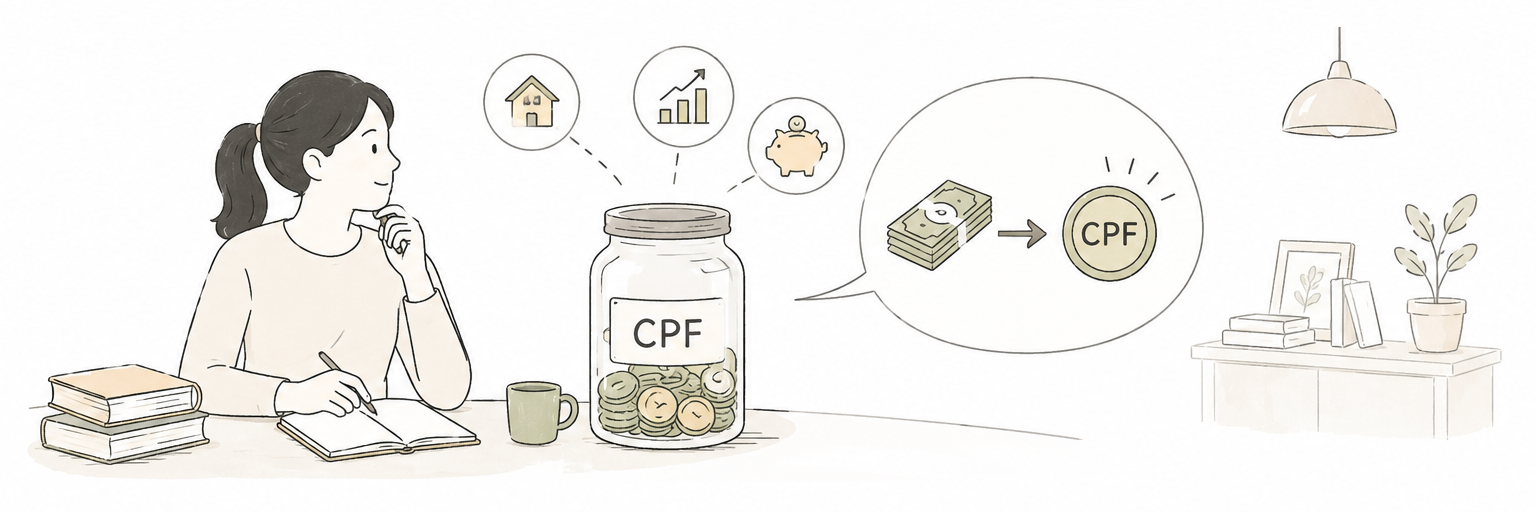
If you have used your CPF savings to pay for your home, you might have heard of a Voluntary Housing Refund (VHR). Simply put, it lets you return cash to your CPF account after using it for your property. By making this move early, you can inject cash back into your Ordinary Account (OA) to unlock three powerful financial advantages: you maximize your cash profits when you eventually sell your home, create a safe, high-yield "time deposit" account, and build a highly flexible retirement income for your future.
Where does the refunded money go, how much interest can it earn, and does your age affect when you can access it again?
Your CPF position at 55 can make a significant difference because your Retirement Account (RA) is created at that point, and the amount you have set aside towards your retirement sum affects what you may subsequently withdraw.
So let's break it down.
First: What is a Voluntary Housing Refund?
When you use CPF savings to pay for your property, the CPF amount used is generally subject to accrued interest. If you later sell the property, the CPF amount used, together with the applicable accrued interest, is generally refunded to your CPF account from the sale proceeds.
A Voluntary Housing Refund is different. Instead of waiting until you sell the property, you can voluntarily return money to your CPF account while continuing to own the property. This can be useful if you have excess cash and want to rebuild your CPF savings.
But where that money ultimately sits — and what you can do with it later — depends partly on your age.
If You're Below 55
For someone below 55, a voluntary housing refund puts money back into your OA.
Why might someone do this? One reason is simple:
You are rebuilding your CPF savings. Money sitting in your OA earns the applicable 2.5% p.a. interest, rather than sitting in a normal bank account earning whatever rate your cash savings happen to receive.
But there is another consideration. If you're approaching age 55, the timing of your CPF refund can become more relevant because your CPF balances are subject to the retirement sum framework.
And this brings us to the more interesting part.
If You're 55 and Above
Once you turn 55, your RA is created. CPF savings from your Special Account (SA) and OA are used to set aside your applicable retirement sum in the RA, subject to CPF rules.
This is where you need to understand the difference between:
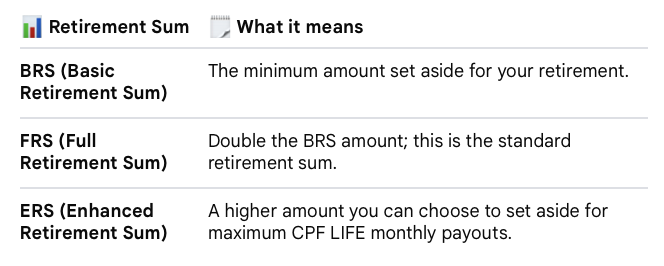
BRS — Basic Retirement Sum
The BRS is the basic amount set aside in your RA to provide for basic retirement needs.
FRS — Full Retirement Sum
The FRS is twice the BRS.
ERS — Enhanced Retirement Sum
The ERS is a higher retirement sum that allows you to set aside more CPF savings for potentially higher CPF LIFE payouts. The applicable retirement sums depend on the relevant CPF year, so don't treat today's dollar amounts as permanent figures.
BRS vs FRS vs ERS — What's the difference?
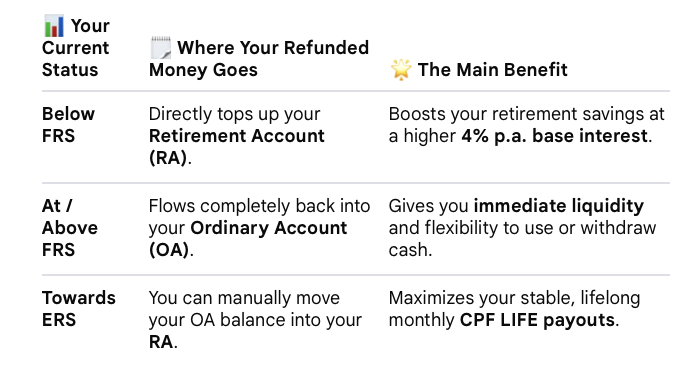
So where does your VHR money go after 55?
Below FRS
If you have not met the applicable FRS, CPF savings can be used to build up your retirement savings, subject to the applicable rules. Your RA earns 4% p.a. base interest, which is higher than the OA's 2.5%.
At FRS / Above FRS / Towards ERS
Once you've met your FRS, the refund puts money back into your OA.
You generally have greater flexibility over CPF savings that are above the required retirement sum. You may choose to set aside more towards the ERS, subject to the prevailing limit. Doing so can increase the amount available for CPF LIFE payouts.
Benefits of a VHR
1. Maximize Cash Profits on a Future Home Sale
This ensures more cold, hard cash in hand from the sale proceeds rather than having it locked away back into your CPF.
2. Create a High-Yield "Time Deposit" Account
When market interest rates drop, finding a safe place to park cash becomes harder. By making a VHR, you effectively move cash into your CPF OA, which acts like a secure time deposit offering a guaranteed 2.5% per annum interest rate.
3. Build a Highly Flexible Retirement Income System (Post-55 Strategy)
For homeowners nearing or over the age of 55 who have already met their FRS, the VHR turns into a massive liquidity loop.
But should you make a Voluntary Housing Refund?
There's no universal answer.
It depends on what you're trying to achieve.
A VHR may be worth considering if:
• You have excess cash that you don't need in the short term
• You want to rebuild your CPF savings
• You value CPF's guaranteed base interest rates
• You're approaching 55
• You are comfortable with the lower liquidity compared with cash
You may want to think twice if:
• You need the cash for an upcoming large purchase
• You have higher-priority financial commitments
• You need liquidity and don't want your money sitting inside CPF
Before making a VHR, ask yourself these 5 questions
01 — How much CPF did I use for my property?
Know your CPF principal and accrued interest position.
02 — How much cash do I actually need?
Don't sacrifice liquidity simply to build up your CPF balance.
03 — How close am I to 55?
Your age can materially affect how you should think about your CPF balances.
04 — Where am I relative to my FRS?
This becomes particularly relevant once your RA is created.
05 — What is the money ultimately for?
Are you trying to rebuild retirement savings, maximise CPF LIFE payouts, prepare for another property purchase, or simply earn interest on excess funds?
The answer can lead to very different decisions.
Final Thoughts
A Voluntary Housing Refund may sound like a simple transaction — put money back into CPF after using it for your home.
But the more interesting question is what happens after the money goes back in.
Your age, CPF balances, retirement sum and future property plans can all change whether making a VHR makes sense for you. So before moving a large amount of cash back into CPF, look at the entire picture, rather than focusing only on the interest rate.
Let's Talk About Your Situation
If this article helped answer some of your questions but raised a few new ones, you're not alone. Every property journey is different. If you'd like to discuss your own situation or have a question after reading this article, feel free to leave me a message below.